math · physics · origami
What a geodesic actually is
Buckminster Fuller, virologists, and origami folders are all building the same object, and here's the great-circle idea that connects them.
2026-06-22
“Geodesic” gets thrown around (geodesic dome, geodesic sphere) and at some point I realized I didn’t actually know what it meant, or why my paper ball had earned the word.
On a flat plane, the shortest path between two points is a straight line. On a curved surface you can’t cut straight through space and stay on the surface, so a geodesic is the next best thing: the straightest path the surface allows, or equivalently the locally shortest route that never leaves the surface. The walking intuition is clean. You’re on a geodesic whenever you’re never steering left or right, just following the ground straight ahead under your feet.
On a sphere, every geodesic is a great circle, a circle whose plane passes through the sphere’s center.11 The equator is a great circle; so is every line of longitude. Lines of latitude, except the equator, are not, which is exactly why they aren’t shortest paths. It’s why a long flight bows toward the pole on a flat map, the route your brain calls a detour and the planet knows is a shortcut. It’s tracing the great-circle arc, the genuine shortest hop, which the flat projection distorts into a curve.
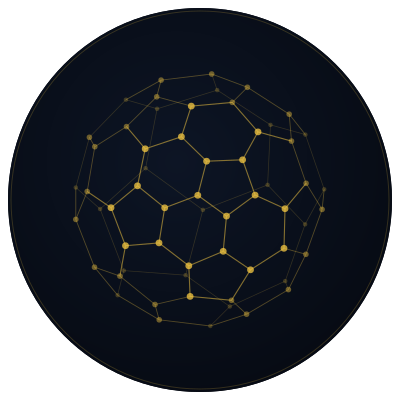
Here’s the link to the ball. Fuller wanted to build a sphere out of flat triangles so that the structural struts would run along great circles, because that spreads load evenly using the sphere’s own natural straight lines. The recipe: take an icosahedron sitting inside a sphere, chop each triangular face into a grid of smaller triangles, then push every new vertex outward onto the sphere’s surface. The strut network you get approximates a web of great-circle arcs. Geodesics. A Sonobe ball is the folded-paper incarnation of that exact skeleton: the chains of units wrap around it in rings that trace those great-circle paths. Color one chain and you can watch a single band circle the entire ball.
The most interesting part is that Buckminster Fuller’s domes, the protein shells of virus capsids, and a paper ball folded at a kitchen table are all the same construction. Subdivide an icosahedron, push the new vertices out to the sphere. Different materials, wildly different scales, wonderfully varied purposes, identical equivalent geometry. A virus, a 1960s utopian, and a bored origami folder, all arriving at the same blueprint, none of them comparing notes.