math · origami
Why a 90-unit Sonobe ball is a pentakis dodecahedron
Each paper unit is one edge of a hidden polyhedron, so the unit count alone tells you the whole shape.
2026-06-22
I folded a 90-unit Sonobe ball, sat back, and realized I had no idea what to call the thing I’d just spent an afternoon making. The answer turned out to be the doorway into a day’s worth of geometric decoding.
The trick is that each Sonobe unit is exactly one edge of an underlying polyhedron, and a little pyramid, a spike, sits on each face. So the unit count isn’t decorative. It’s a hard constraint that names the solid.
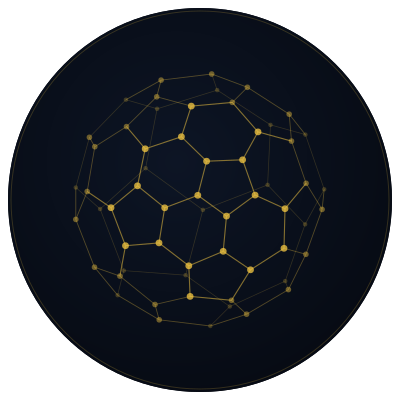
90 units means 90 edges. The polyhedron with 90 edges and the icosahedral symmetry these balls have is the pentakis dodecahedron: 32 vertices, 90 edges, 60 triangular faces. Because the spikes sit on the faces, the ball has 60 three-sided spikes, formally a stellated pentakis dodecahedron, though everyone just calls it a 90-unit ball.
Took a lot of googling, here’s the recipe: parse pentakis dodecahedron as penta–kis–dodecahedron: start from a dodecahedron (12 pentagons), apply kis (raise a pyramid on each face), and because the faces are pentagons, each one splits into 5 triangles.11 “kis” is the operator “raise a pyramid on each face”; the prefix tells you which face is being capped. Pentakis = pyramids on pentagons. Twelve pentagons times five triangles is sixty triangles. The whole kis family works this way: triakis caps triangles, tetrakis caps squares, pentakis caps pentagons.
Love a good sanity check: 60 triangular faces, 3 edges each, divided by 2 because every edge is shared by two faces, gives edges. 90 units, the exact stack on my desk, ninety little parallelograms quietly judging me. The count is non-arbitrary, QED.
For comparison, the starter 30-unit ball is built on the bare icosahedron (30 edges), and the next clean step up, 270 units, is a frequency-3 geodesic icosahedron with 270 edges and 180 spikes. Which raises the obvious question, why those numbers and not others? Cliffhanger!