math
Loeschian numbers and the Eisenstein integers
Why 'rounds nicely' secretly depends on the prime factorization of T, a tour down to the Eisenstein integers.
2026-06-22
The whole Sonobe story rests on one condition, , and I kept treating it as a black box, the way you nod along to a friend explaining their crypto. The numbers it produces are called Loeschian numbers, and the reason some integers are Loeschian and others aren’t is genuinely deep.
A quick refresher on notation first, since the rest leans on it. means and leave the same remainder when divided by . A clock is the everyday version: . Working mod 3 just sorts every integer into three bins by remainder: the multiples of 3, the ones that leave remainder 1, and the ones that leave remainder 2.
The test for whether is Loeschian, prime by prime:
- primes : free, any power
- the prime 3: free, any power
- primes : allowed only to even powers
That instantly explains the puzzles from the paper-budget note. is prime and , so it contains zero troublesome primes and sails through. And sure enough . Meanwhile : here appears to the first power, an odd power, so 95 is not Loeschian, and no Sonobe ball lands there.
Why are the primes the troublemakers? This is the part that made me put the paper down and stare at a wall for a while. The form factors:
where is a primitive cube root of unity, satisfying . That product is a norm, the squared size of the number in the ring of Eisenstein integers, the triangular lattice of points in the complex plane.11 The Eisenstein integers are to a 60° triangular grid what the ordinary integers are to the number line. And it’s the very same triangular grid your Sonobe faces tile. And the behavior of an ordinary prime in that ring is exactly what the mod-3 rule is tracking:
- splits: it factors into two Eisenstein primes whose norms multiply back to , so it can contribute any power.
- stays inert: it remains prime in the Eisenstein integers, and the smallest norm it can contribute is , which is precisely why it’s forced to even powers.
- is the lone ramified case, sitting on its own.
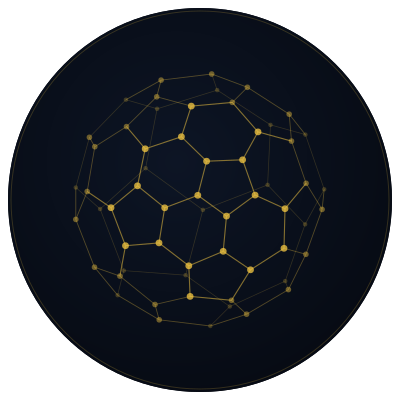
So the question “will my paper ball round nicely?” reduces, after enough unfolding, to “how does this number factor in the Eisenstein integers?” The triangular lattice the units physically sit on is the same lattice the number theory is secretly about. The paper knew before I did. The geometry and the algebra were never two different things, which, after six notes, feels like the right place to stop.